If You’re Asking for Curriculum Help, Which Role Do You Actually Need?
By Betsy Kostolni, M.S.Ed., of Learning Experience Strategist Services
If you’re asking for “curriculum help,” the real question may be this:
Which role do you actually need?
Curriculum-related roles are often grouped together as if they do the same work. They don’t. And when those differences aren’t understood, expectations get blurry, and learning efforts can miss their mark.
I see this confusion show up often in my work, especially when organizations are trying to move quickly or do more with limited capacity.
Over time, I’ve noticed that confusion tends to fall into two common patterns:
Assuming one role or title can (or should) do everything
Using the same title to mean very different kinds of work across organizations
Both create misalignment before the work even begins.
Curriculum Roles Exist on a Spectrum
Rather than thinking in terms of job titles alone, it’s more helpful to think about scope and focus.
Curriculum roles sit on a spectrum. On one end is big-picture strategy and learning vision. On the other is hands-on build and technical implementation. Problems arise when organizations expect someone at one end of the spectrum to operate fully at the other.
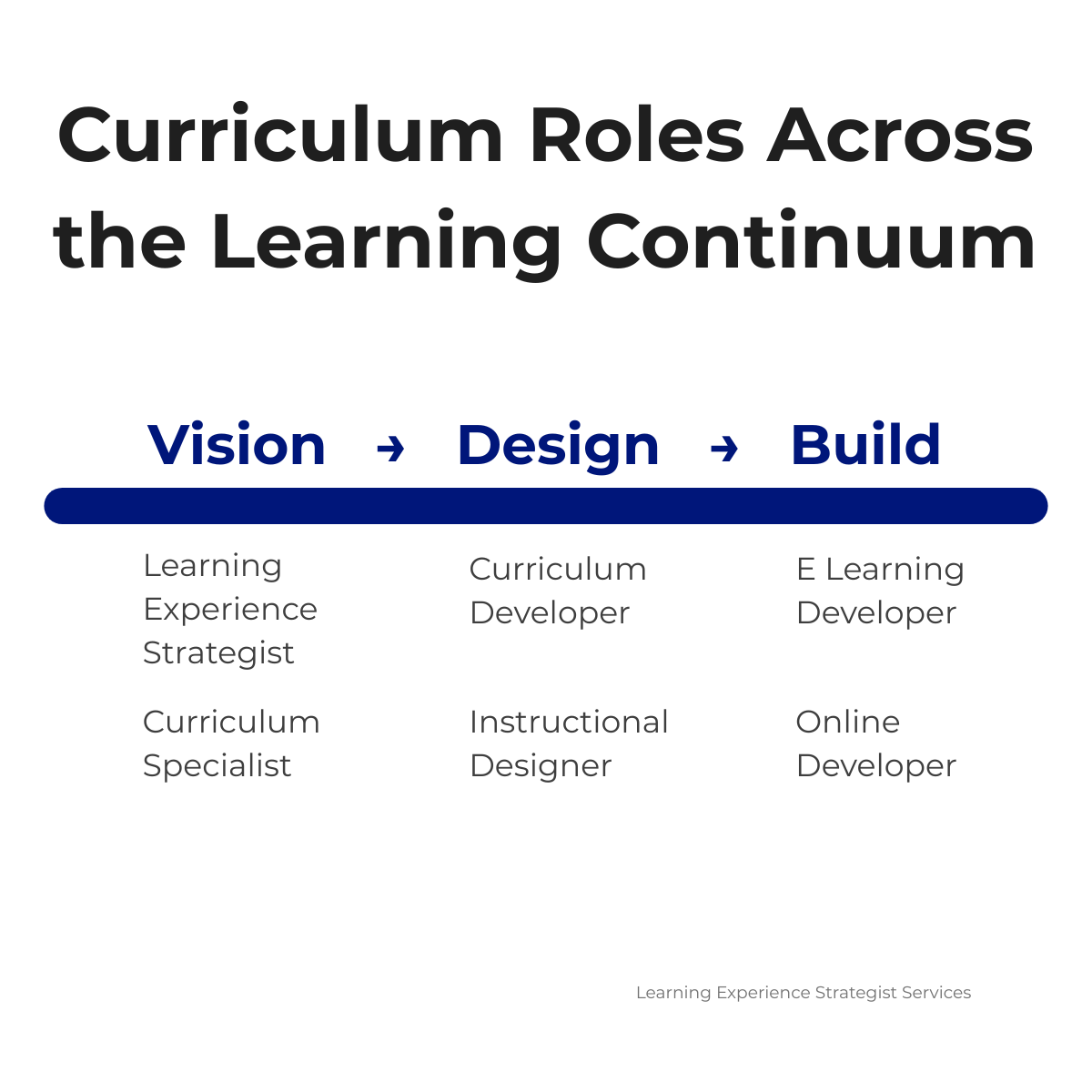
Curriculum roles exist along a continuum from vision to design to build. Clarifying the scope and focus of each role helps organizations align expertise, set realistic expectations, and create learning experiences that work.
Below is a simplified way to understand the most common curriculum-related roles and how they differ.
Learning Experience Strategist
Sets the vision
A Learning Experience Strategist focuses on the entire learning journey, not just individual courses or materials.
This role clarifies performance goals, defines what success looks like, and ensures learning efforts align with organizational priorities. The work is less about creating content and more about making intentional decisions: why learning exists, who it serves, and how it should function within a larger system.
This role often translates complex needs into a coherent learning strategy that others can execute.
Focus: Vision, alignment, learning architecture
Primary question: What problem is learning meant to solve, and how should it work as a whole?
Curriculum Specialist
Evaluates and improves what exists
A Curriculum Specialist reviews curriculum for quality, alignment, and compliance. This role typically looks across courses or programs to assess effectiveness and identify gaps or inconsistencies.
Rather than designing from scratch, the focus is on evaluation, refinement, and improvement. Curriculum Specialists are often responsible for ensuring standards are met and that the curriculum holds together at the program level.
Focus: Review, quality assurance, program coherence
Primary question: Is this curriculum effective, aligned, and meeting expectations?
Curriculum Developer
Defines what is being taught
Curriculum Developers are responsible for defining the structure and substance of learning.
They map learning outcomes, assessments, and objectives using a curriculum framework to ensure alignment. This role determines what learners are expected to know or do and how progress will be measured.
Focus: Outcomes, assessments, instructional alignment
Primary question: What should learners learn, and how will we know they have learned it?
Instructional Designer
Designs how learning happens
Instructional Designers take a curriculum framework and design the learning experience itself.
This role applies learning theory, cognitive research, and evidence-based strategies to create engaging learning experiences across formats, whether in-person, blended, or online. The emphasis is on flow, purpose, and behavior change, not just content delivery.
Instructional design bridges intention and experience.
Focus: Learning design, engagement, application
Primary question: How should learning be designed so it actually works?
E-Learning Developer
Builds the course
E-Learning Developers handle the hands-on construction of digital learning experiences.
Using authoring tools and a learning management system, this role takes the instructional designer’s blueprint and transforms it into a functional, usable online course. Attention to detail, technical quality, and learner experience are critical here.
Focus: Build, usability, execution
Primary question: How do we turn the design into a working digital course?
Online Developer
Develops and maintains learning systems
Online Developers work closer to web or IT development than instructional design.
This role focuses on building, customizing, or maintaining platforms, systems, or applications that support online learning. While the work enables learning, it is primarily technical in nature.
Focus: Platforms, systems, technical infrastructure
Primary question: How do the systems that support learning function and scale?
Why These Distinctions Matter
Titles vary widely across organizations. What matters most is not the title itself, but the scope of responsibility attached to it.
In many organizations, especially smaller ones, one person is asked to perform several of these roles at once. Sometimes that’s unavoidable. But without clarity, it often leads to:
Unrealistic expectations
Overloaded roles
Learning efforts that are difficult to scale or sustain
Missed opportunities to support learning effectively
Understanding these distinctions helps leaders make better decisions about staffing, contracting, timelines, and support.
How This Shows Up Across Contexts
If you’re working in a K–12 school system, a higher education institution, or an organization, these roles often look different depending on context, scale, and internal capacity.
I outline how learning strategy, curriculum development, instructional design, and course development typically function across each setting here:
K–12 Curriculum & Learning Support: https://domorewithless.net/k-12
Higher Education Curriculum & Course Design: https://domorewithless.net/higher-ed
Organizational Learning & Training Design: https://domorewithless.net/organizations
A Final Thought
Different roles bring different depth. But the goal is always the same: learning that works.
When organizations take the time to clarify what kind of curriculum support they actually need, learning becomes more intentional, more effective, and more sustainable. That clarity benefits everyone involved, the leaders, designers, developers, and, most importantly, learners.
Clarity around roles doesn’t just make the work easier; it makes learning better.
This blog reflects the work and perspective of Learning Experience Strategist Services. Learn more at https://domorewithless.net.
