Alignment Isn’t About Adding More. It’s About Designing Learning That Works.
By Betsy Kostolni, M.S.Ed., of Learning Experience Strategist Services
When learning lacks clarity or coherence, the issue is rarely effort. It’s a design issue.
Educators, institutions, and organizations are working hard. They’re creating lessons, developing materials, and delivering instruction with care and commitment. Yet learning can still feel confusing, fragmented, or misaligned.
More effort isn’t the answer.
Intentional design is.
Starting With the End in Mind
One of the most influential shifts in curriculum and training design came when Grant Wiggins and Jay McTighe challenged designers to start with the end in mind.
Backward design reframed how we think about learning. Instead of beginning with content or activities, it asks us to begin with clarity around results.
Backward design isn’t about adding more content or more tasks. It’s about the intentional connection between:
What learners should know or be able to do
How learning will be evaluated
What success looks like
How instruction supports progress toward that success
When design begins with clarity around results, learning becomes more coherent, more meaningful, and more effective for both learners and instructors.
Strong learning experiences don’t happen by accident.
They are built through intentional alignment.
Why Alignment Is Often Misunderstood
Alignment is sometimes mistaken for compliance or completeness, including more objectives, more activities, and more documentation.
But alignment isn’t about adding more.
It’s about designing learning that works.
When alignment breaks down, it often looks like:
Outcomes that are unclear or too broad
Assessments that don’t truly or authentically measure what matters
Criteria that are implicit or not aligned with outcomes
Instruction that feels disconnected from expectations
These issues don’t reflect a lack of care or expertise. They reflect a lack of design clarity.
The L.E.S.S. Curriculum Alignment Framework
To support clearer, more intentional design, I use the L.E.S.S. Curriculum Alignment Framework. It clarifies how the essential parts of the curriculum and training connect when design starts with clear results.
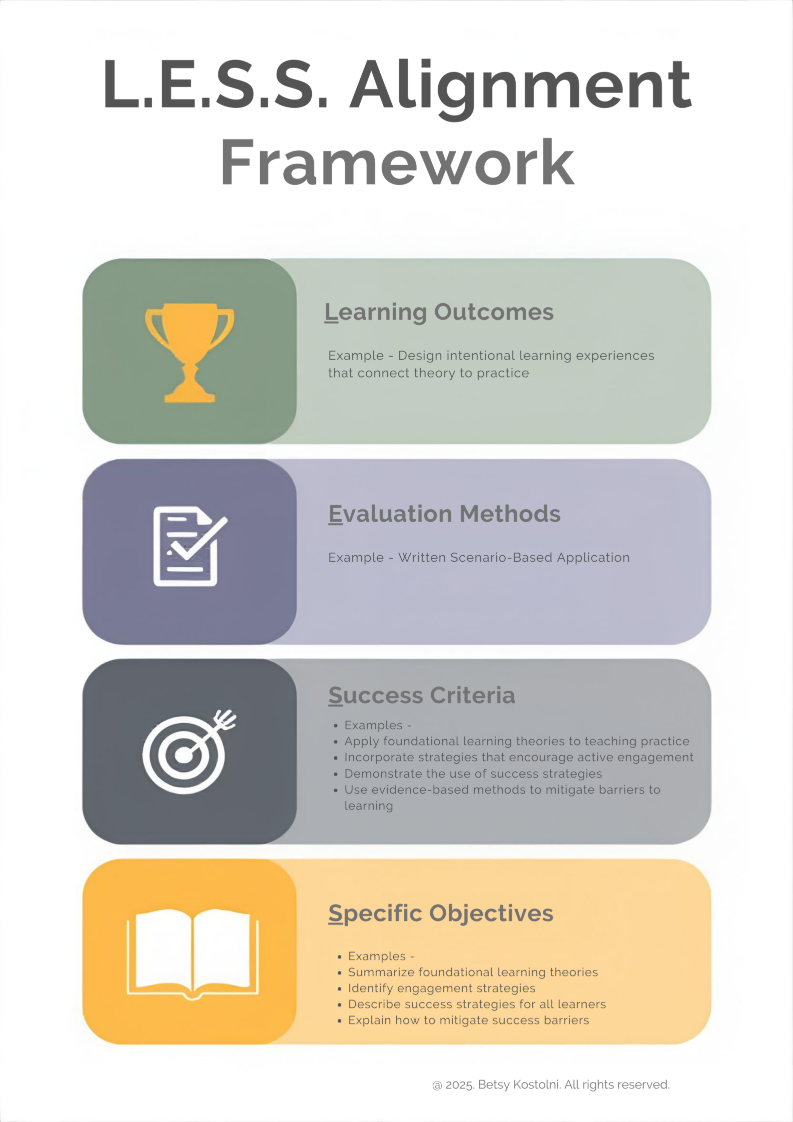
Examples of learning outcomes, evaluation methods, success criteria, and specific objectives within the L.E.S.S. Curriculum Alignment Framework.
Learning Outcomes
What learners must know or be able to do at the end of a course, program, or learning experience.
Evaluation Methods
How learners demonstrate achievement of the outcomes.
Success Criteria
What must be demonstrated within the evaluation to show successful performance.
Specific Objectives
The knowledge and skills learners need to develop in order to meet the success criteria.
When these four elements are intentionally aligned, learning becomes:
More coherent
More meaningful
Easier to design and facilitate
Clearer for learners
Alignment supports stronger instructional confidence and learning experiences built on purpose, not guesswork.
Alignment Across Contexts
Alignment shows up differently depending on context, scale, and learning environment. The L.E.S.S. Curriculum Alignment Framework is designed to be used across settings, while allowing flexibility in how it is applied within K–12 school systems, higher education institutions, and organizations, each of which operates with different constraints and expectations.
You can learn more about how common curriculum and training challenges show up in each setting and how I support teams working through them here:
K–12 Curriculum & Learning Support: https://domorewithless.net/k-12
Higher Education Curriculum & Course Design: https://domorewithless.net/higher-ed
Organizational Learning & Training Design: https://domorewithless.net/organizations
Alignment as a Design Mindset
Alignment isn’t a one-time task or a checklist item. It’s a design mindset.
When alignment is present, educators and trainers can make clearer decisions about:
What to include and what to leave out
How to design instruction that truly supports learning
How to assess learning in ways that are fair and meaningful
When alignment is missing, learning often feels harder than it needs to be for everyone involved.
A Final Thought
Alignment doesn’t require more effort.
It requires clearer intention.
When learning outcomes, evaluation methods, success criteria, and specific objectives are intentionally connected, learning works better, not because more was added, but because design decisions were made on purpose.
How does alignment show up in your work?
This blog reflects the work and perspective of Learning Experience Strategist Services. Learn more at https://domorewithless.net
